REEL: An Interview with Colleen O’Brien
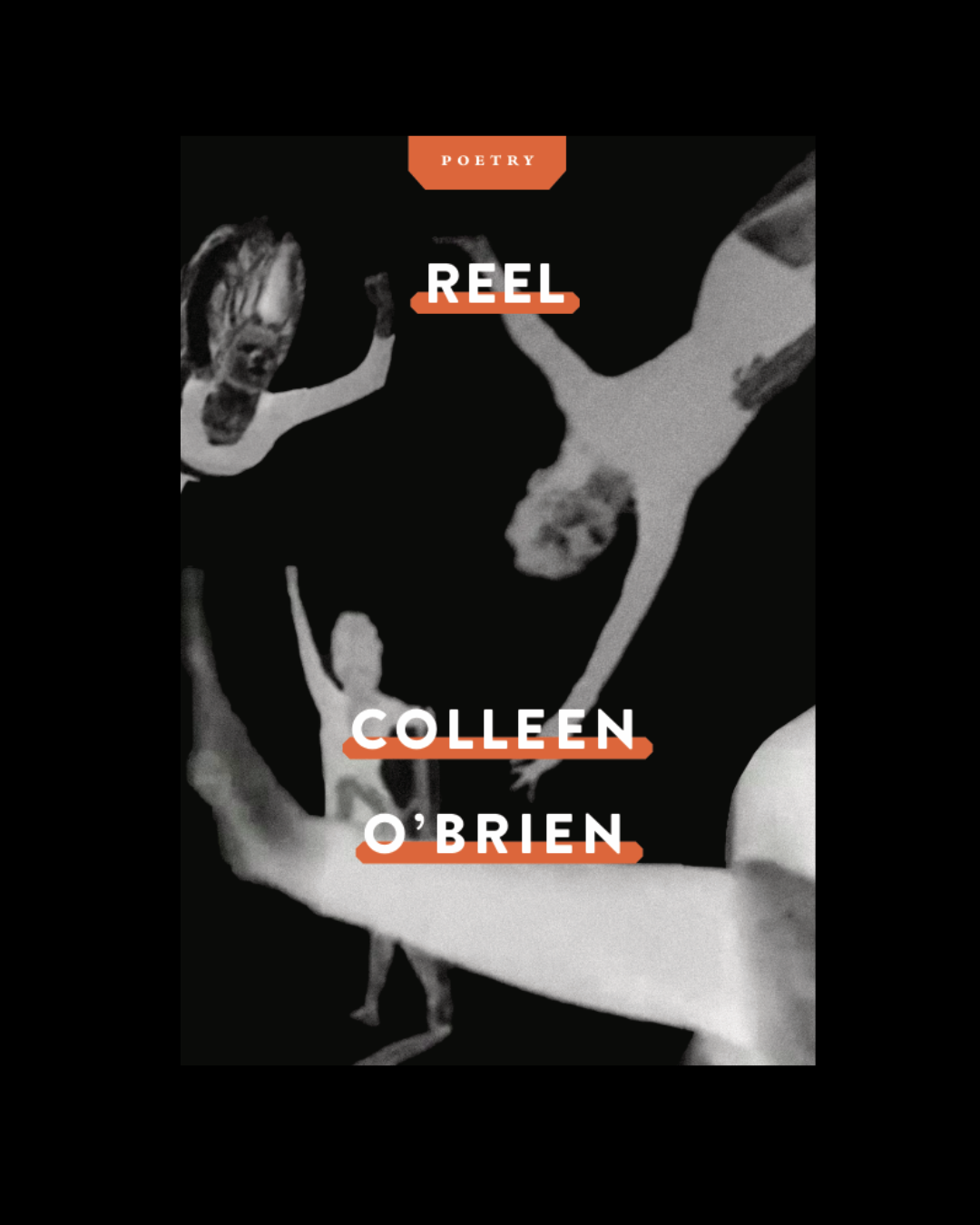
GS: This collection is organized into five different acts, each churning with the rich contemplation of bodily perception, internal and interpersonal isolation, and the overwhelmingness of the human experience—how did you come to this arrangement? Did the arc reveal itself as more poems were added? Or did you have to dig deeper to unearth their connections?
CO: The manuscript started as just a big pile of the poems I had, and over a period of years, I added, cut, and rearranged many times. I read it aloud, start to finish, pretty often, and could hear and feel when something was off—this poem’s wrong in this spot, this poem shouldn’t be in the book at all. The same was true for the things that started to feel right: hearing the words aloud illuminated continuities I hadn’t noticed, and brought out patterns in sound, tone, and form.
GS: Reel is your first full-length poetry collection. You also published an award-winning chapbook, Spool in the Maze, in 2015, and a collection of short stories, All Roads, in 2022. In formulating and assembling Reel, can you talk about how your process may have differed from, connected with, and/or expanded upon your previous writing experiences? Was there anything that surprised you while working on this collection specifically?
CO: When I write fiction, I’m often consciously trying to figure out how I feel about something. I don’t necessarily know what’s going to happen in a story, but there’s usually a character with something urgent they’re working through, and I have at least an inkling of why that’s urgent to me. Poetry has been a very different mode for me. It’s much more driven by sound and playfulness, as well as the space between what language tries to express and language itself. Something that surprised me writing Reel was how that mode could be a path into the same kind of urgency that drives my fiction. I can start with “this image interests me” or “these words sound cool” and make my way to something I’ve badly needed to let myself feel or understand.
GS: One of your poems, “Bethlehem,” “borrows” and “distorts” lines from different works, including playwright William Shakespeare’s “Macbeth”, poet Marianne Moore’s “In Distrust of Merit”, and rock band’s The Zombies’ “Tell Her No”—can you discuss your personal connection(s) with literature and music? How does reading and/or listening to other mediums usually affect/inspire/influence you as a writer? What are you reading/listening to right now?
CO: Reading and listening to music are really crucial for me, as are looking at visual art and watching movies. Feeling moved by someone else’s words, sounds, images, and decisions about arranging them in time and space reminds me how much depth and complexity there is in all of us and how important it is to show that to each other. It’s really hard. It takes so much patience and commitment. But good art makes it obvious that it’s worth it.
Everything I’ve read or listened to has gotten into me on some level. Old poems and prayers, songs and jingles, familect, movie quotes, sound bites, isolated fragments of other languages. Some of it stays with me because it’s beautiful and true, offers me a world I want to believe in, but a lot of it feels chaotic and random. I love the jumble of it, the puzzle, the dream-logic of etymologies and brand names, everything we do with and to language, for richer or for poorer, in sickness and in health. Right now I’m reading Pauline Oliveros’s Deep Listening: A Composer’s Sound Practice and trying to set aside time to listen to albums straight through, no multitasking, just listening.
GS: In the collection’s final poem, “Those Are Pearls,” you re-imagine and offer a new and—mind the pun—reeling perspective to the popular nursery rhyme, “Row, Row, Row Your Boat”. What made you decide to finish the arc with this piece? With what did you wish to leave readers?
CO: That “Row, Row, Row Your Boat” is a round song is what delighted me at first—the way the lines are designed to overlap when sung in a round, so we hear, “gently down the stream [your boat]” and “life is but a dream[ily merrily]” and all these other permutations. There’s a sense that the song doesn’t end, because when one singer finishes, another’s just getting started, and the one who could’ve been finished now feels compelled to jump back in. For me, there’s a sense that you go until you can’t, till the joy dries up or your throat hurts, but that the song itself is there anytime you want it, and if that’s the case, so is every song?
There’s also a feeling like at the end of a game of Tetris when it’s just too fast and too many pieces pile up—this is a state of mind I find myself in often, metaphorically something like listening to this song and hearing only the “merrily merrily” line, where every beat is crammed with syllables and every word’s the same. You can stay there, or you can change the channel and tune to “Life is but a dream [rest]. Life is but a dream [rest]. Life is but a dream [rest].” That version of the song is playing simultaneously with all the others. Instinctively, this felt like a good place to end. Overwhelm, but also infinity and possibility.
GS: Finally, if a genie appeared right now and granted you three wishes (related to writing, publishing, personal or non-personal, etc.—your choice), what would you choose? Please note, unfortunately, the mysterious genie has nearly exceeded its daily wish quota and cannot offer more than the three—but everything else is fair game!
CO: The first would be for some kind of steadiness or depth of wisdom that lets me just write and trust the writing, not look outward for approval, while remaining connected to others and their good work, allowing myself to be changed by them, allowing them to help peel away whatever in me has died off and needs to be shed.
The second would be for every person who writes to keep doing it. Whatever that looks like for them. I won’t go as far as to say we eliminate all stress and confusion related to writing, because that might be one of those careful-what-you-wish-for things. But if I could write up this wish like a contract, I’d put a ceiling on the stress if it stops you from writing or from more important things, like having friendships and taking care of yourself. I want a community and I want it to thrive, for selfish and unselfish reasons.
The third would be a bottomless supply of good notebooks, pencils, pens, erasers, pencil sharpeners and cases, these days even highlighters and editing flags, Post-its, index cards, I know the word for this is “office supplies” but I’m really enjoying typing out each separate name. At the end of every semester, I’d give my students an awesome kit to take with them wherever they go next. Same kit for any writer I encounter ever, stranger or friend… add to the wish that these items materialize on demand, so I don’t have to drag them around in a wagon.
Colleen O’Brien is a poet, writer, and professor at Lehigh University. She is the author of the poetry collection Reel (CSU Poetry Center, 2025), the short story collection All Roads (TriQuarterly/Northwestern University Press, 2022), and the award-winning chapbook for DIAGRAM’s chapbook contest Spool in the Maze (New Michigan Press, 2015). Her work has appeared in The Gettysburg Review, Fence, Kenyon Review Online, The Antioch Review, Denver Quarterly, West Branch, and elsewhere. She is a recipient of the Pushcart Prize for her fiction.
Gianna J. Somrak, native to Highland Heights, Ohio, is a poet, writer, and first-year NEOMFA candidate. She received her BA in creative writing and BS in psychology from Baldwin Wallace University. Her work has appeared in BWU's The Mill Journal 2022-2023, 2023-2024, and 2024-2025 editions, Radio on the Lake Theatre, and Cleveland.com. She enjoys journaling, baking bread, and rewatching Netflix's Stranger Things in her spare time.