WINDOWER: An Interview with Michael Loughran
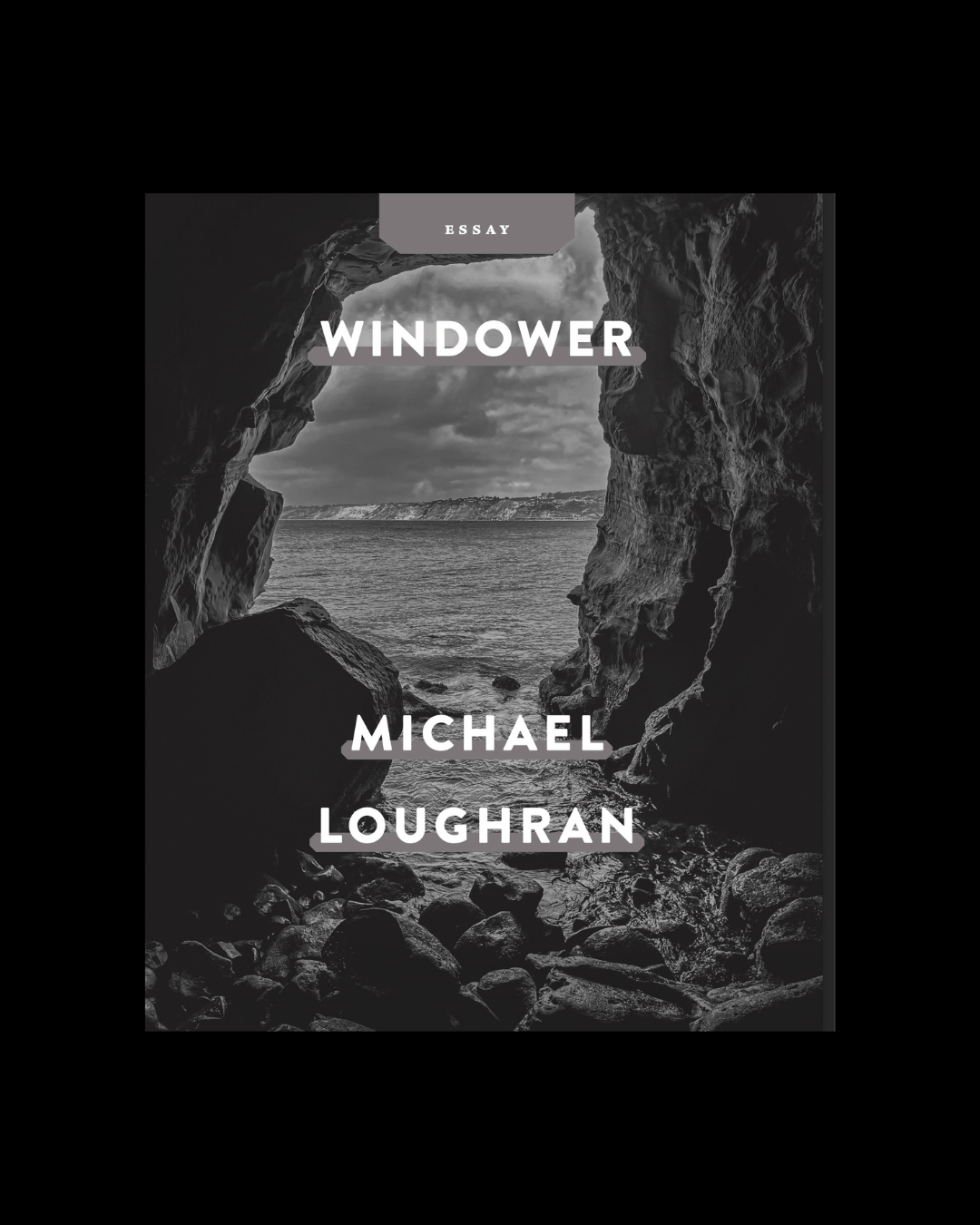
KT: At one point in Windower you say, “I didn’t want to write this book after all, it seems.” This writing exists in the aftermath of your first wife’s death, because of the knowing that followed her death. What ultimately compelled you to keep going and to want to write this book?
ML: Windower came after a long time of not writing, when I was having the years of unaccountability described in the book. I would say to people that I was quote unquote done with writing, done with poetry (I had been a poet) and that I was happier for it. Which in a way was true–I felt I’d failed at poetry, having never published a book of it. So when I retired from it, I loved not having any of the writerly ambitions, jealousies, or insecurities. But then the ambition came back and really clobbered me, dragged me up the hill where the book was. I had done a lot of therapy, every type. I’d thought so much about my story, whatever that word came to mean or is coming to mean, about how I felt it would kill me if I didn’t do something, about how it could really mess things up generationally, and I thought, as I began writing, that I could organize this so-called story in a way that might defang it. Part of what it means for me to have published it is that I can stand back from it and try to see the grief and shame of it all differently. It’s a little box of secrets I wanted to tell, which turned out to be easier than wondering who knew them and who didn’t. I didn’t want anyone to have anything on me. I didn’t want myself to have anything on me, either.
KT: I'm wondering about this “retirement” of poetry. When you began to write again, was prose the only mode that made sense? Where are you at with poetry now?
ML: In the book, I think about the wild freedom of my grief, the bottomlessness of it. You know when you see babies on the beach, sitting in the surf and spanking the sand? I regressed like that. I’ve since seen it on the faces of other grievers, too. The thing is, grievers are wise and can be fun to be around. When we grieve, we often give ourselves permission to be who we want and to say what we want. So anyway, it turns out what I really wanted was to write books like whatever Windower is. Nobody was looking over my shoulder, nobody cared. I wrote the exact book I wanted. I haven’t had any instinct for poetry since Noelle died. It just flew away, is how it feels. Some of my dearest friends are poets, and their poems and books I still read, with love and interest and some brief flashes of the old feeling. But I just don’t have the same intuitions about it that I used to. I don’t understand why they do it, or why I did.
KT: You mention reading Joan Didion’s work, particularly her book The Year of Magical Thinking. Didion’s work invites readers into her grief but never fully collapses the boundary between her private experience and the public page. How did you decide how close to bring your reader to the most intimate moments?
ML: I read Joan Didion all at once about halfway through the five years I worked on Windower. Sometimes I was trying to write like her, distant and cool like her. But then I encountered two other big writers I’d never read, these two French angels who oversaw Windower from on high. I read A Simple Passion byAnnie Ernaux, which I think is the one that has the story where she can’t find her contact lens but then finds it stuck to the man’s you-know-what. When she does that stuff it makes me feel like all other writing is just a sick joke waste of time. To every other writer I’m like, tell me your contact lens story, whatever it is for you, and tell it to me as quickly as possible, or I’m going to scream.
And then I came across Emmanuel Carrere, it was totally an accident that he’s also French, I wasn’t trying to read books by French writers or anything like that. In all his books, and they’re all incredible, he keeps prying himself open and not in a cute or self-regarding way. If he were a young American writer he’d be the king of autofiction but I like to think of him as having no idea what’s going on in literature, he’s just cranking out what he calls “nonfiction novels” with this genuine bemusement about his own life and choices and ethics. When I read him I feel like I’m on fire, I can’t believe he’s doing it, and it’s a gift. That’s what intimacy feels like, a total miracle. That feeling when you realize you’re going to kiss someone or they’re going to kiss you? That’s how Carerre feels to me.
Another way to say it: when I would bring a reader close to the most intimate moments, as you say, it felt true to the book. I wanted a reader to trust me—this may sound stupid but I wanted a reader to trust me that I’d tried it every other way. “I’m sorry, reader, but I have to say this.” I guess I wanted the book to whisper all this stuff, whisper all these little stories. When other writers whisper to me, I want to live forever. Whoever whispers like that, those are my people.
KT: In this book, the window becomes a guide, a kindness, a fence to keep one safe. Multiple times, windows show up in-scene as part of the setting, especially during the final confrontation with the Furies. You describe your father-in-law, for example, looking through a sunroof, and how the sunroof honors the natural world by framing it. Can you talk about your attention to windows and how this image became central to the book?
ML: The book is interested in the allure of symbols, the comfort of them, and it’s suspicious of them, too, but one point it wants to make that bridges those intuitions is that symbols are symbols because they’re real. The things that repeat in Windower—windows, fire, cars, tents—they’re in the book because they’re in the world. I mean, they aren’t primarily ideas. If you look up right now, there’s probably a window near you. Oh, and couches! There’s most likely a couch very near you right now. So with windows, they just kept appearing in the book, and then that can be an organizing principle. The stuff that repeats, you leave it there, you play it up, you put more windows in, and then one day you realize you’re trying to end your book and phew, here comes another window.
KT: This book is about a loved one’s suicide. Suicide carries particular weight and stigma in public discourse. This work avoids sensationalizing suicide, aestheticizing it, and rejects reductive certainty around it. How did you approach the ethical responsibility of portraying it on the page?
ML: I’m glad it seems that way to you. Thanks for mentioning that. I’m struck by your phrase “ethical responsibility.” I’m trying to think if I ever felt that while I was working on it. I don’t think I did. I think I felt an aesthetic responsibility to the book, or to put it worse, I wanted to write a good book. I wanted to write something useful. So it’s true I had thought quite a lot about how to avoid those things you mention the book avoiding. And truly, I’m grateful to anyone who sees I avoided them and takes the time to tell me so. That’s meaningful to hear. I didn’t want to be a bad person in my efforts to write a good book. But here’s the thing, and I forget if it’s alluded to or said outright in the chapter called “The Volcano”—I’m not exactly sure what I wouldn’t do to write a good book.
KT: Memoirs often involve writing about other people who didn’t choose to be portrayed. I am thinking about the difficulty of navigating this, especially when writing about family. How did you decide which parts of this story were and were not yours to tell?
ML: I’m afraid of this question. I never answered it to my satisfaction, and now the book is fresh in the world. I expected I’d have some clarity on it by now. Something I’m particularly unclear about is what we mean when we say “not our story to tell.” At the far, unacceptable end, I’d put something like straight gossip—something a person could write about someone else about which we as readers would say “that has nothing to do with you; you have no right.” But that’s not the kind of case anyone who reads my book is asking about. Or anyway, there’s a lot I knew to disinclude from the book because it was obviously wrong to include it. What people are asking about is the vast grey sea of things that happen relationally, i.e. things that happened (for instance) to me and Noelle, or between us. I guess I just think everything worth writing about concerns our lives with others. At work, I am in charge of a small program that studies intellectual history. I try never to make a choice I couldn’t explain simply to my dean. And that’s the policy of Windower. I took a lot of care, I did my best. If anyone needs to pull me into the dean’s office about something, I have my sentences. But that’s not the same as clarity or peace.
In terms of the cast of real humans in the book, I didn’t ask any of them if it was okay. I hoped it was, and I wanted them to feel good about it, but I didn’t ask. I had MJ’s approval to write about our life together, to tell the story of how we fell in love so soon after Noelle’s death, but I don’t know if that permission was implicit or explicit. I mean, I don’t think she was hoping I would one day write a book about us, but she joined me in the mission and in so many ways we wrote the book together. All I can say in my defense is I worried a lot, I worried about every corner of Windower.
KT: Many writers, from Didion to Barthes, acknowledge the impossibility of “truth” in writing about loss. Didion, for example, emphasizes that memory itself is unreliable and fractured by grief. In writing Windower, how did you navigate the tension between accuracy, the poetics of expression, and the force of emotional truth?
ML: Oh, it’s such a twisted and funny thing: you can’t possibly tell the truth about this stuff, but the only way forward is to convince yourself you can. You have to believe it all the way. You have to believe language works in order to get properly heartbroken that it does not. It’s like free will. It’s like rooting for your sports team. It’s like religion. Windower quotes the famous “I believe because it is absurd.” It’s absurd to think you could capture grief in a book. It’s absurd to think anyone would want to read it even if you could. But you have to get there. You have to lock the door and get to work.
KT: Throughout this book, you turn to Aeschylus’s Oresteia and the Furies as a framework. How did these myths help you articulate your experience of loss? What does myth allow that straightforward memoir cannot?
ML: I teach this little book by Karen Armstrong where she says myths are true because they’re effective, not because they’re True. She was a nun, so she would know. I didn’t intend to say anything about tragedy when I set out. I just feel like they’re useful, and I wanted to write a book that was useful, and that desire got me wrapped up in all sorts of tangents and tangles. I was like a loose fire hose who wrote a book. So the myths in Windower, like much else of it, helped me get at some stuff sideways that I could not properly square myself up to. I take them literally in ways I try to make clear in the book. The Furies are here. It’s just true. Athena’s here, too. She’s right here next to me.
KT: I am interested in this phrasing of wanting to write a book that was "useful" because it’s the second time you’ve said this. Was it in the forefront of your mind that you wanted this book to benefit others?
ML: That’s a great question. At some point, yes. Not at first. At first I was merely digging my way out of my old life. MJ read it all the time, in so many versions, and she was hard on it. “You haven’t started yet,” she said to me. I was a few years in. She really wanted me to write the hard stuff. She helped me see how the book could be useful to others. A lot of my early drafts were filled with so many pretentious digressions. I was being defensive because I didn’t think anyone would care about my story. But she helped me see how they could, if only I could open up enough to let them in. For a long time I didn’t listen to her. I pretended to listen, but I kept doing what I’d been doing. It’s hard work teaching me; I’m really good at convincing myself and others that I understand things I do not in fact understand. And because the writing of Windower was contemporaneous with the reckoning I was having with my own shame, understanding I could try to write something useful meant also understanding I was not myself ruined. I myself am useful, was the lesson. In therapy parlance, that’s my work. Windower thinks of honesty and truth as slippery things, but it believes very much in trying to grab them, and I guess it believes to be honest about one thing is to be honest about everything. That’s its use, I hope.
Michael Loughran’s work has appeared in Boston Review, Indiana Review, Harvard Review, Tin House, and elsewhere. He lives in Philadelphia and teaches at the Community College of Philadelphia.
Kristen Tetzmann is a poet and painter from Wisconsin working as an editorial assistant in the CSU Poetry Center. She is a third-year poetry candidate in the NEOMFA program and is also a bookseller at Mac’s Backs. Her work has appeared in Bodega Magazine, Furrow, and elsewhere.